Pain Solutions for Pianists
“This helped a lot in terms of relieving the shoulder tension and pain, and the wrist and elbow pain too.” - Helen
Play Piano Without Pain
And Understand Why It’s Happening
If you’re experiencing discomfort or pain at the piano, you’re not alone. Many pianists experience these sensations at some point. It can develop gradually or swiftly, and if it lingers long enough, we may quietly start to wonder “Maybe I’m not cut out for this.”
Some people decide to just endure it. I’ve heard of pianists who popped a couple Tylenol before they played. That would make me consider quitting altogether.
Playing can also feel confusing and unpredictable: one day it feels fine, and the next day your arm or wrist hurts again, even though you didn’t consciously change anything. In many cases the issue isn’t simply playing too much or needing to relax. It’s usually related to how the body is organized and moving at the instrument.
To improve this, we need to explore the mechanics of comfortable playing: how the bench setup and your entire body - torso, neck, head, arms, hands, fingers, legs, and feet - all work together. Then, we can retrain movements so playing feels coordinated and natural again.
This isn’t about “relaxing more.” It’s about understanding how your body actually works at the piano.
Start with a Technique Assessment.
The assessment is the starting point. We’ll look at your setup, movement patterns, and where discomfort may be coming from. You’ll leave with at least one clear adjustment to experiment with. From there, we’ll decide whether single lessons or a more focused 4-week reset makes the most sense.
Common Problems I Help Pianists Solve
Students arrive with a variety of issues:
• Wrist pain when playing scales
• Forearm fatigue after practicing
• Thumb pain in chords
• Shoulder or neck tightness at the keyboard
• Technique that feels inconsistent or unreliable
In many cases the root cause is how the body is organized and moving at the instrument.
I’m a jazz pianist and Taubman-based teacher. After rebuilding my own playing from tendonitis, I now help pianists understand the movement patterns behind pain, tension, and unreliable technique.
Hi, I’m Jordan.
If you’re still figuring out what’s going on, start with my free guide:
📄 3 Common Causes of Piano Discomfort (and Ways to Fix Them)
This PDF resource walks you through:
Three common setup problems
How they tend to look and feel
How to address each one
What We Actually Do
This work is not generic piano instruction.
It’s a focused process of identifying and retraining the movement patterns that are creating discomfort and pain.
Step 1: Careful Assessment
We look closely at:
How bench height and distance affect your comfort and movement
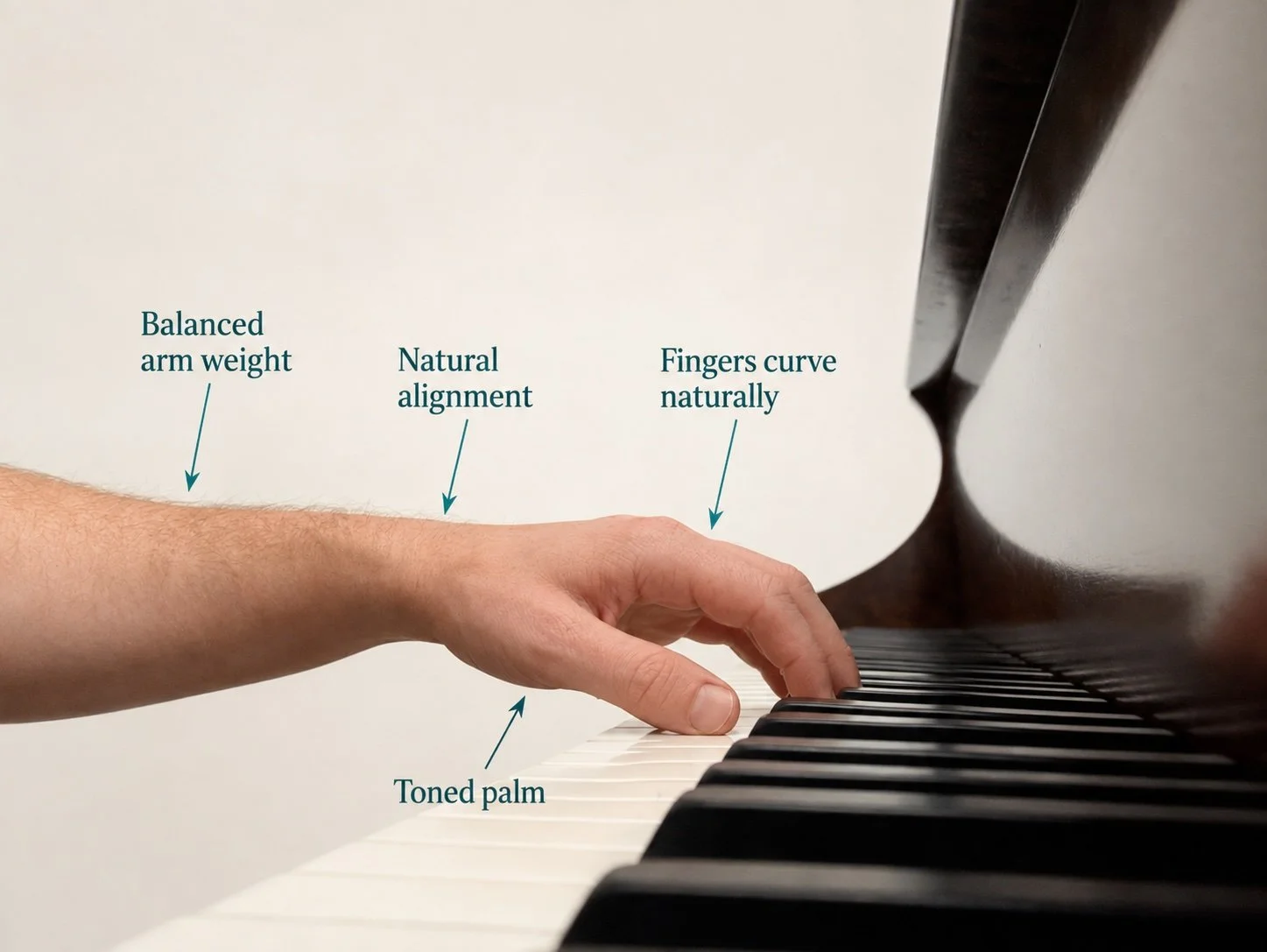
Natural alignment between the hand, wrist, and forearm
How the torso supports the arm when moving across the keyboard
How different parts of the body coordinate when producing sound
In that first session, most students have a moment where they say: “Oh wow. That actually feels better.”
Step 2: Movement Foundations
We explore specific movements and learn how the torso, forearm, and hands can work together naturally.
This may involve:
Learning how to shift your weight comfortably on the bench
Playing single notes and simple patterns
Open-ended, movement-based exploration
Learning to effectively notice and differentiate between two options
Playing small fragments of pieces with specific skills in mind
Often, even small adjustments begin to improve how things feel.
Step 3: Integration into Real Music
As healthy movement becomes clearer, we begin to apply it directly inside your repertoire.
The goal is not just less pain. It’s a reliable technique that lets you play real music with more comfort, freedom, and control.
We will:
Choose pieces, or portions of pieces, to work on for specific technical skills.
Devise a clear practice plan, including how much and what to practice.
Employ science-backed practice strategies to retrain movement and learn music effectively.
“The lessons with him have completely transformed how I play and even sit at the piano.”
- Eliya (Illinois)

Which path fits you?
Not every pianist needs the same kind of help. Some people just need a clear first look at what’s going on. Others will need a more structured reset. We can figure that out together.
Technique Assessment
Best if you’re not sure why playing hurts, feels tense, or breaks down. We’ll look at your setup, movement, and playing habits so you leave with a clearer sense of what’s causing the issue and what to try next.
Single Lessons / Occasional Help
Best if you want guidance on a specific piece, pattern, or technical problem without committing to a longer process. This can work well if the issue is fairly contained.
4-Week Technique Reset
Best if discomfort keeps coming back, your technique feels unreliable, or you want a focused period of retraining. We’ll work step by step on setup, coordination, and applying healthier movement to real music.
Not sure? That’s completely fine.
Most students don’t know which option fits before we meet. The Technique Assessment is the best place to start.
Why This is Different
Many pianists are told to relax more. Or take more breaks. Or strengthen their fingers.
Those suggestions might help temporarily, but they often don’t address the underlying movement patterns.
After over a decade studying piano mechanics through the Taubman approach and rebuilding my own playing after tendonitis, I now help pianists identify and correct the movement patterns that cause discomfort and pain.
It’s the reason I can still perform and teach comfortably.
What to Expect in Your First Session
Your Technique Assessment includes:
A careful look at your current setup and movement
Identification of likely setup and movement problems
At least one clear movement adjustment to experiment with
Honest feedback about whether this process is a good fit for you
There’s no pressure! The first session is exploratory and gentle. We won’t push through difficult playing.
I love helping pianists play comfortably again.
Set up your Technique Assessment below.
Schedule a Technique Assessment
You don’t need to commit to a long program. This session is simply a careful look at what’s happening and whether this approach is a good fit.
You’ll hear back within 24 hours.
“These lessons helped me return to piano after years of pain.” — Alex (Michigan)
FAQs
Is this physical therapy?
No. This is retraining your piano technique. We focus on movement and mechanics at the instrument. If you have a medical concern, consult your healthcare provider. What we do is examine how you’re playing and adjust movement patterns accordingly.
How quickly do people feel changes?
Many students notice meaningful differences in the first session. Long-term changes take consistent work, but early improvements are common.
What if my pain is severe?
We move gently. In some cases we work with very small patterns or even a single note at a time. The pace depends entirely on where you are starting.
Does this work remotely?
Yes. Many pianists don’t have access to a local teacher who can help with this work. We can effectively assess your setup and technique virtually, as long as you have wifi and a good webcam. Students have learned from across the world, from Scotland to Singapore.
Do I need to study a specific style?
No. This work applies across classical, jazz, and other repertoire. The focus is movement, not genre.
Is this only for advanced pianists?
Not at all. Pain and inefficiency can occur at many levels. The process is adapted to your experience and goals.
If you’re tired of guessing why something hurts and you’d like to understand what’s actually happening, start with an assessment.
Comfortable playing is often closer than it feels.